
What I Was Trying to Accomplish
I publish a weekly newsletter.
It's not huge. About 1,200 subscribers. But it's consistent. Every Tuesday, it goes out. Every Tuesday, it takes me about 4 hours to produce.
That's too long. I wanted to cut it in half. So I built a workflow. Here's the full process, the prompts, and where AI helped and where it didn't.
What I Used
Tools: A general-purpose AI assistant (free tier) and a newsletter platform (Substack)
Input: A running list of ideas, a rough draft, and a set of past newsletters
Time available: About 2 hours
Goal: A complete newsletter, ready to send
The Workflow
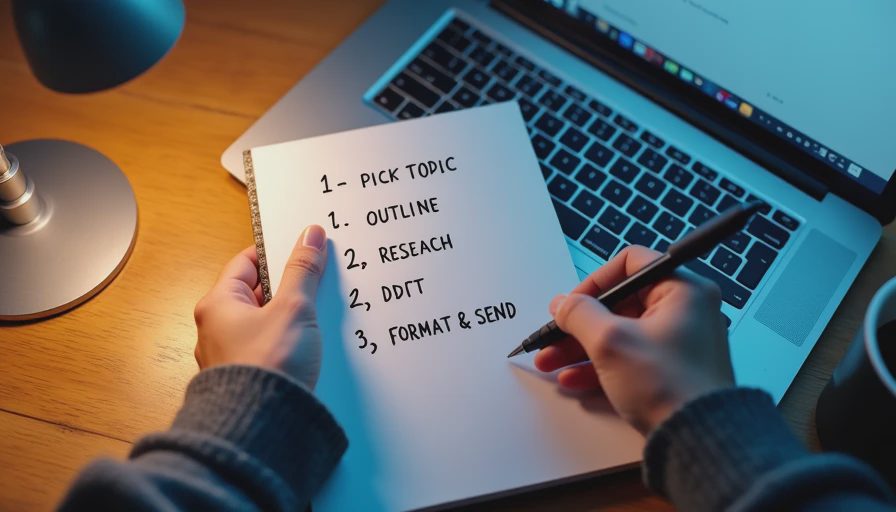
The workflow has six steps.
Step 1: Pick the topic. I review my running list of ideas and pick one. (5 minutes)
Step 2: Outline. I use AI to turn the idea into a rough outline. (10 minutes)
Step 3: Research. I gather sources, examples, and data. (30 minutes)
Step 4: Draft. I use AI to produce a first draft based on the outline and research. (15 minutes)
Step 5: Edit. I rewrite, add voice, add personal anecdotes, and fix errors. (45 minutes)
Step 6: Format and send. I format the newsletter, add images, write the subject line, and schedule it. (15 minutes)
Total: about 2 hours.
The Prompts
Here are the exact prompts I use.
Prompt 1: Outline
"Here is a topic for my newsletter: [topic]. Here is my audience: [description]. Here are three past newsletters that performed well: [excerpts]. Create a rough outline with an introduction, three main sections, and a conclusion. Keep it simple. Do not write the full draft yet."
Prompt 2: Draft
"Here is the outline: [outline]. Here is my research: [notes]. Write a first draft of the newsletter. Keep it under 1,200 words. Use plain language. Do not use jargon. Do not use clichés. Include specific examples. Write like a human talking to a friend."
Prompt 3: Subject Line
"Here are three subject lines I've used before: [examples]. Here is the newsletter topic: [topic]. Write five subject line options. Keep them under 50 characters. Make them specific. Avoid clickbait."
The Result
Here's what the workflow produced for a recent newsletter.
Topic: How to use AI for customer follow-up without sounding robotic.
Outline (AI-generated):
Introduction: Why follow-up matters
Section 1: The problem with generic follow-up
Section 2: How AI can help (without sounding like a robot)
Section 3: A simple follow-up workflow
Conclusion: Start small
Draft (AI-generated):
The draft was about 1,100 words. It followed the outline. It used plain language. It included specific examples. It didn't sound like a robot.
Subject lines (AI-generated):
"How to follow up without sounding robotic"
"AI follow-up that doesn't sound like AI"
"The follow-up mistake you're probably making"
"A simple follow-up workflow for busy teams"
"Stop sending generic follow-ups"
I picked #1.
What I edited:
I added a personal anecdote about a follow-up I sent that went wrong. I rewrote the introduction to be more engaging. I added a specific example from my own experience. I cut about 100 words. I added a call to action at the end.
What the Workflow Does Well
It's fast. Two hours instead of four. That's real.
It's consistent. I use the same prompts every week. The output format is consistent.
It gives me a starting point. Instead of staring at a blank page, I have an outline and a draft.
It saves the worst minutes. The blank page. The staring. The "where do I start?" The AI gets me moving.
It's repeatable. I've used this workflow for a few months. It works every week.
What Still Needs My Attention
It misses context. The AI doesn't know my audience. It doesn't know my voice. It doesn't know what I've already written about.
It misses the personal element. My newsletter is personal. It's about my experience. The AI can't provide that. I have to add it.
It misses the examples. The AI gives generic examples. I have to replace them with real ones.
It misses the call to action. The AI doesn't know what I want readers to do. I have to add that.
It misses the final polish. The AI draft is a starting point, not a finished product. I still have to edit.
The Math
Without the workflow: Writing a newsletter from scratch took about 4 hours.
With the workflow: Writing, editing, and formatting took about 2 hours.
Time saved: About 2 hours per week. That's real.
What I'd Change
I'm still refining the workflow. Here's what I'm considering.
Adding a voice line. Something like "Write in my voice: conversational, honest, slightly self-deprecating." That might help.
Adding a "what I've written before" line. Something like "Here are topics I've already covered." That might prevent repetition.
Adding a personal anecdote prompt. Something like "Ask me a question about my experience that would fit this topic." That might help me add personal stories.
Using a better subject line tool. I'm testing a few subject line analyzers.
My Question for You
What does your newsletter workflow look like?
Do you use AI? Do you use a different process? Do you write everything by hand?
I'm curious what works for other people. I've been using this workflow for a few months. It's not perfect, but it's better than spending 4 hours on every issue.

