
The Take
I've been using AI tools for a while now. Not casually. Seriously. I've tested multi-tool workflows. I've built automation chains. I've connected apps. I've spent hours optimizing prompts.
And I've come to a conclusion.
Adding more AI tools usually makes a workflow worse.
Not always. But usually. The more tools you add, the more friction you create. The more time you spend maintaining the system. The less time you spend doing the actual work.
I know this is a hot take. I know some people love their tool stacks. But I've been on both sides. I've built complex systems. I've simplified them. The simple ones won.
Why I Think This
Here's my reasoning.
Every tool adds friction. You have to open it. You have to learn it. You have to remember how it works. You have to switch between tools. That friction adds up.
Every tool adds maintenance. Tools update. Integrations break. Prompts need tuning. You have to keep the system running. That's time you could spend on actual work.
Every tool adds cost. Not just money. Time. Attention. Mental load. You have to manage the tool. You have to decide when to use it. You have to check its output.
Every tool adds a point of failure. If one tool breaks, the workflow breaks. If one integration fails, the system fails. The more tools, the more fragile the system.
Every tool adds decisions. Which tool for this task? Which tool for that? You spend more time deciding than doing.
A Real Example
Let me give you a real example.
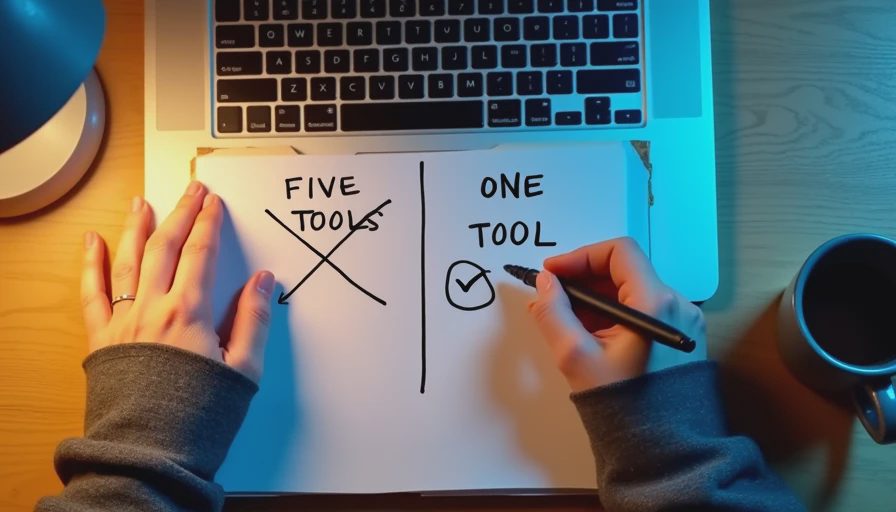
I built a content workflow. It had five tools.
One tool for writing. One tool for research. One tool for summarization. One tool for scheduling. One tool for analytics.
It looked impressive. It looked efficient. It looked like the future.
It also took me two hours to set up. And another hour to maintain each week. And ten minutes every time I used it to remember how it worked.
I used it for a month. Then I simplified.
I picked one tool. I used it for everything. Writing. Research. Summarization. Scheduling. Analytics. One tool did all of it.
The result? I saved more time than I ever did with the complex system. And I spent less time maintaining it.
The Counterargument
Here's the best counterargument I've heard.
"Complex systems save time in the long run. You invest in the system, and it pays off over months."
I used to believe this. I don't anymore.
Complex systems don't save time in the long run. They save time in theory. In practice, they create new problems. They need maintenance. They create friction. They break.
Simple systems save time immediately. You pick a tool. You use it. You do the work. That's it.
What Works Better
Here's what I think works better.
One tool. Pick one AI tool. Learn it well. Don't switch every week. Don't try to use five tools at once. Just one.
One habit. Pick one habit. Maybe it's using AI for first drafts. Maybe it's using AI for meeting notes. Maybe it's using AI for brainstorming. One habit. Do it consistently.
One workflow. Pick one workflow. A simple one. Something you do every week. Maybe it's a weekly report. Maybe it's a content plan. Maybe it's a customer follow-up. One workflow. Refine it over time.
That's it. One tool. One habit. One workflow.
What About Specialized Tasks?
I know what you're thinking. "But some tasks need specialized tools."
That's true. If you're doing video editing, you need video editing tools. If you're doing image generation, you need image generation tools. If you're doing transcription, you need transcription tools.
But most people aren't doing those things. Most people are writing, researching, summarizing, and organizing. Those tasks don't need specialized tools. They need one good tool.
The Challenge
So that's my take.
Adding more AI tools usually makes a workflow worse. Not always. But usually. The friction, the maintenance, the cost, the failure points—they add up.
I want to hear your experience.
Have you built a complex workflow that actually works? Have you simplified and seen better results? Do you disagree with me? Tell me why.
I'm genuinely curious. I've been wrong before. I might be wrong now.